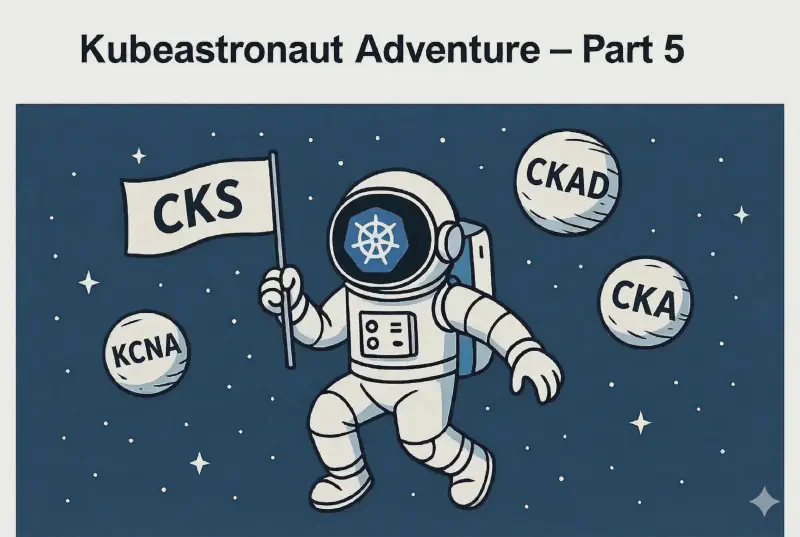
Well, here we are. The final chapter. CKS is done, and I am officially a Kubeastronaut.
If you’ve been following this series, you know I called CKS “the final boss” back in Part 4. Turns out, I wasn’t being dramatic enough. This thing didn’t just push me—it pushed me off a cliff, waited for me to climb back up, and then pushed me again.
But I climbed back. And now I’m wearing a spacesuit.
The First Attempt: A Tragicomedy
Let me be honest with you—I failed the first attempt. Scored 60%. You need 67% to pass. That means one more correct answer, maybe two, and I would have had it.
One answer. The exam didn’t just fail me—it let me smell the finish line, then gently closed the door in my face. If this were a movie, this would be the scene where the hero falls to his knees in the rain.
But it wasn’t rain. It was just me, staring at the screen, thinking: “I knew security was my weak point. I literally wrote about it in the last post.”
The Second Attempt: This Time With Feeling
I wasn’t going to let this dragon win. So I went back to the lab, sharpened my sword, and prepared properly this time. My study stack stayed faithful:
- KodeKloud: Their CKS course is excellent. Thorough, well-structured, and the hands-on labs actually prepare you for the real thing. I went through the entire course and it filled the gaps I didn’t even know I had.
- Killer.sh: You already know the drill—these practice exams are harder than the real thing. That’s the whole point. If Killer.sh is the nightmare, the actual exam becomes a manageable dream. Well, maybe not a dream. But you survive.
- KillerCoda: The interactive exercises were a nice change of pace. Sometimes you just want to break things in a browser without any setup overhead. Fun and effective.
And of course, my trusty local cluster was there for me once again. No cloud bills, no fear of breaking production, no Slack messages asking why the staging environment is on fire. Just me, my machine, and an endless willingness to destroy and rebuild.
I went through everything—AppArmor profiles, Seccomp policies, RBAC configurations, network policies, audit logging, supply chain security—the whole beautiful, terrifying catalog. I broke things. I fixed them. I broke them again, this time on purpose. That’s how you learn.
The second attempt went differently. Not because the exam got easier—it didn’t—but because I had internalized the material instead of just memorizing it. The difference between “I’ve seen this before” and “I understand this” is the difference between 60% and passing.
The Kubeastronaut Moment
With CKS cleared, all five certifications are now in the bag:
- KCNA — Kubernetes and Cloud Native Associate
- KCSA — Kubernetes and Cloud Native Security Associate
- CKA — Certified Kubernetes Administrator
- CKAD — Certified Kubernetes Application Developer
- CKS — Certified Kubernetes Security Specialist
Five exams. Five different flavors of “please configure this cluster before the timer runs out.” And now, the journey that started as a curious adventure has officially reached orbit.
There is something poetic about the fact that the hardest exam—the one I failed first—was also the last one standing between me and the finish line. Every good story needs a final boss, and CKS played its role perfectly.
What I Learned (Beyond the Technical Stuff)
Failing the first CKS attempt was the best thing that could have happened. It forced me to confront my weakest area head-on instead of dancing around it. In Part 4, I wrote that security wasn’t my natural habitat. Well, after weeks of living in that habitat, it feels a lot more like home now.
If you’re on the same path, here’s what I’d tell you: don’t fear the fail. It’s just expensive feedback. And break things on purpose—if you’re afraid to destroy your lab environment, you’re not learning fast enough.
What’s Next?
The rockets have been fired. The spacesuit is on. The certifications are earned. But the cloud-native universe keeps expanding, and so will I.
Now if you’ll excuse me, I have a local cluster that needs breaking.
See you in orbit. 🚀